The Anti-To-Do List Method: Get More Done by Doing Less
What Is an Anti-To-Do List?
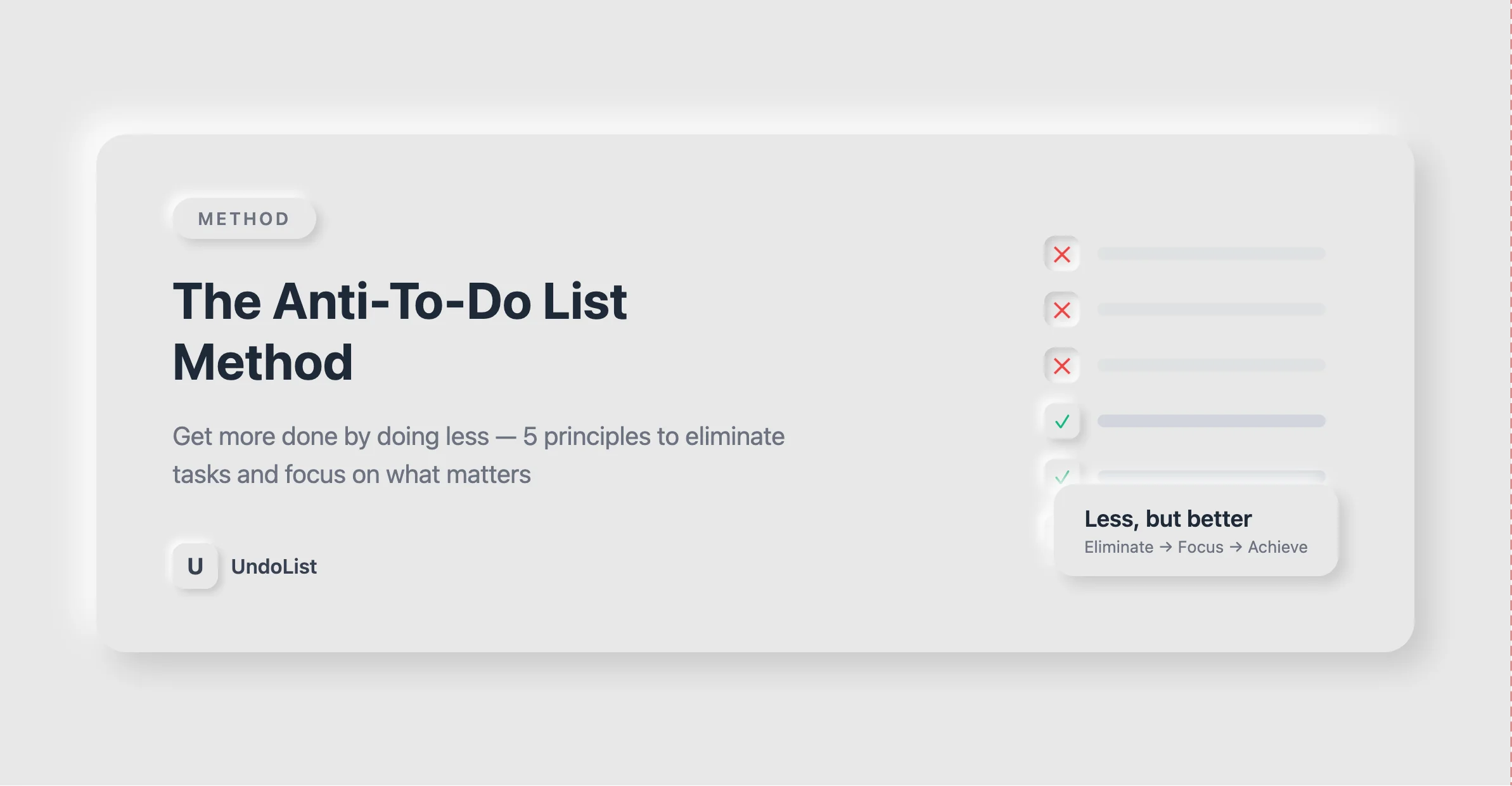
An anti-to-do list is a productivity method that focuses on identifying and eliminating tasks rather than accumulating them. Instead of tracking what you need to do, an anti-to-do list helps you consciously decide what NOT to do — freeing mental space and energy for what truly matters.
Unlike traditional to-do lists that grow endlessly, an anti-to-do list is a subtraction-based approach to intentional productivity. It asks not "What should I add?" but "What should I remove?"
Think of it as the reverse of your current system: most productivity tools encourage addition. An anti to do list app encourages subtraction — because clarity comes from what you choose NOT to do, not what you manage to do.
Traditional To-Do vs. Anti-To-Do Thinking
The difference between these two approaches runs deeper than surface-level habits. It's a fundamental shift in mindset.
| Traditional To-Do | Anti-To-Do | |---|---| | Add every task that comes to mind | Capture, then question every task | | Success = more items checked off | Success = more items eliminated | | Organize tasks better | Have fewer tasks to organize | | Manage your time | Protect your time | | Do more, faster | Do less, better | | Growth mindset | Subtraction mindset | | Reaction-based | Intentional-based | | Endless optimization | Finite constraint |
The shift from traditional to anti-to-do thinking is what makes the difference between being busy and being productive. One approach maximizes your output quantity. The other maximizes your output quality.
When you're trapped in traditional thinking, you're optimizing for the wrong thing. You're getting better at managing more — but "more" isn't the point. The anti-to-do method recognizes that productivity isn't about volume — it's about value.
This philosophical shift is what allows truly productive people to accomplish more by attempting less. They've realized that their time and energy are finite resources, and spending them on the wrong tasks isn't just wasteful — it's actively counterproductive.
The 5 Core Principles of an Anti-To-Do List
1. Capture Everything First
Paradoxically, the anti-to-do method starts by writing everything down. You need to see the full picture before you can start cutting. How to shorten your to do list? First, see how long it really is.
The capture phase is judgment-free. Empty your head onto paper (or into an app like UndoList) without filtering, prioritizing, or judging. This creates psychological safety — you know everything is captured, so you can now make thoughtful choices about what to keep.
Most people skip this step, thinking they can just keep everything in their head. But the brain is terrible at holding and organizing information reliably. By capturing everything externally, you free up mental bandwidth for the actual work of evaluation and decision-making.
This brain dump isn't just a task list — it's a repository of everything that might need attention. From this repository, you'll select only a tiny fraction to work on. The key insight: capture everything, do little.
2. Question Every Item
For each task in your capture, apply the elimination filter. The reverse to do list method means working backwards — instead of deciding what to do, decide what to remove.
This questioning interrupts automatic behavior. Instead of the default "add to list" reaction, you pause. You evaluate. This pause creates space for intentional choice.
The three-question framework in UndoList makes this systematic:
-
Does this align with my goals? Most tasks we take on are reactions to other people's priorities — not choices we've made consciously. A coworker asks for help, we say yes. A friend invites us to something, we agree. Over time, our to-do list becomes a collection of other people's priorities, not our own.
-
What happens if I don't do this? Often, the honest answer is "nothing important." Many tasks feel urgent in the moment but have negligible long-term impact. They're fake emergencies created by artificial deadlines and someone else's urgency. When you pause to consider consequences, most items on your list become obvious candidates for elimination.
-
Is this the best use of my time today? Compare the task against everything else competing for your attention. If it's not in your top three priorities for today, it probably shouldn't be on your list at all. This question forces comparison and prioritization, which is the essence of the anti-to-do method.
3. Apply "Hell Yes or No" Rule
Popularized by entrepreneur and writer Derek Sivers, the "Hell Yes or No" rule states that if a task doesn't excite you or isn't clearly essential, it's a no.
This principle is at the heart of the anti to do list app approach. It forces you to recognize that declining most opportunities isn't a failure — it's essential for focus.
Every "no" creates capacity for a "hell yes" on something truly important. Protecting this capacity is the most productivity-enhancing decision you can make. When you say no to the good (the mediocre), you preserve your ability to say yes to the great.
The difficulty of applying this rule reveals how overcommitted most people are. When you first start using the "hell yes or no" framework, you'll be surprised how few tasks actually pass the test. This isn't a sign that you're lazy — it's a sign that you've been saying yes to too much.
4. Embrace the Power of "Not Yet"
Some tasks aren't wrong — they're just not right for today. Learning how to use a not to do list includes knowing when to shelve something for later without guilt.
UndoList's "Maybe Later" feature provides this psychological safety net. You're not deleting tasks — you're parking them. But crucially, you're NOT committing to do them. This distinction frees you from the pressure of infinite backlog while still respecting the value of potential future tasks.
The "not yet" mindset acknowledges time as a constraint without abandoning potential opportunities. It's different from procrastination because it's a conscious choice about timing, not avoidance. "I'll review this next week" is a strategic decision. "I'll get to it eventually" is procrastination.
This principle prevents the anxiety of losing ideas while maintaining the clarity that comes from having a finite focus for today. It's the middle ground between "yes now" and "no forever."
5. Celebrate Elimination
Traditional productivity celebrates completion: checking things off your list. The anti-to-do method celebrates elimination: removing things from consideration.
UndoList includes deletion tracking — you can see your "Didn't Do" history and weekly focus summary. This reframes productivity from doing more to doing less.
Your deletion rate becomes a metric of success, not failure. A high deletion rate means you're getting better at identifying what doesn't matter. That's true productivity improvement.
When you eliminate a task, you're not just "not doing it" — you're actively choosing to not do it. There's a profound difference. The former is passive; the latter is active. The former is avoidance; the latter is prioritization.
Celebrating elimination also creates a positive feedback loop. Traditional to-do lists train your brain to feel good when you add tasks and check them off. Anti-to-do lists train your brain to feel good when you eliminate tasks — which aligns much better with your actual goals of reducing overwhelm and focusing on what matters.
How to Start Your Anti-To-Do List Practice
The anti-to-do list is not just a concept — it's a daily practice. Here's how to begin:
1. Brain Dump
Write down every task weighing on your mind, every worry, every "should." Don't filter. Capture everything into a single place. This is your starting point for how to shorten your to do list.
Set a timer for 5-10 minutes and write continuously. Don't judge, don't organize, don't prioritize during this phase. The goal is complete capture, not pretty capture. Think of it as a brain dump onto paper — the messiness of the initial draft is actually a feature, not a bug.
2. Review Each Task
Apply the three-question filter. For every captured item, ask yourself:
- Does this align with my goals?
- What happens if I don't do this?
- Is this the best use of my time today?
Be honest. Be ruthless. Remember that the anti-to-do method works on subtraction, not accommodation. Your goal isn't to find reasons to keep items — it's to find legitimate reasons to eliminate them.
For each task, there are only four possible outcomes: do today, schedule for later, delegate to someone else, or eliminate entirely. The "eliminate" option should be your default unless you have a compelling reason otherwise.
3. Eliminate Ruthlessly
Remove everything that isn't essential today. Be honest about what's truly important. Remember: saying no creates space for saying yes to what matters.
The ruthless elimination phase is where most people struggle. We want to keep things "just in case" or "when I have time" — but those are almost always cop-outs. If a task doesn't align with your goals, won't have significant consequences if you don't do it, and isn't the best use of your time today, it needs to go.
4. Keep Only 3
Force yourself to identify the most important tasks. The constraint is what creates clarity. If everything feels important, nothing is. If three tasks is too few, reconsider your definition of "important."
The "3 tasks" rule isn't arbitrary — it's a cognitive constraint that matches working memory capacity. When you limit to three, you force yourself to make real trade-offs. This prevents the analysis paralysis that comes from trying to prioritize among dozens of competing demands.
5. Reflect Weekly
Review your elimination patterns. What types of tasks do you consistently remove? What do you tend to keep? Use these insights to refine your decision-making over time.
This weekly reflection transforms the anti-to-do list from a daily tactic into a strategic practice. You'll start to recognize patterns in your own behavior — perhaps you consistently say yes to requests that don't align with your goals, or perhaps you hold onto tasks due to guilt rather than genuine importance.
UndoList: The Anti-To-Do List, Digitalized
UndoList takes the anti-to-do list method and makes it a daily digital practice. With guided reflection questions, a hard 3-task limit, and deletion tracking, it's an elimination strategy turned into an app.
Instead of yet another task management tool, UndoList is a focus management tool — the first app designed to help you do less, intentionally.
Key features that support the anti-to-do list method:
-
Unlimited capture inbox — Get everything out of your head first. No filtering during capture, just pure, unfiltered output. The judgment comes later, during reflection, not during the initial brain dump.
-
Three guided questions — Built-in elimination filter for every task. The app asks the three critical questions for you, making it automatic rather than requiring willpower in the moment.
-
Hard 3-task limit — Forces intentional prioritization. You literally cannot add more than three tasks to your focus list. This constraint isn't a limitation — it's liberation from choice paralysis.
-
"Maybe Later" shelf — Guilt-free deferral of non-essential tasks. Park tasks for future consideration without committing to a backlog. The Maybe Later section is your safety net, not your prison.
-
Deletion tracking — Celebrate what you've removed. See your "Didn't Do" history and track your weekly deletion rate. Turn elimination into a positive metric of success.
-
Weekly summaries — See patterns in your elimination over time. Understand what types of tasks you consistently remove, what you tend to keep, and use these insights to improve your decision-making.
Ready to try the anti-to-do list app? It's free, private, and requires no account.
The Mental Shift
Adopting the anti-to-do list method requires more than just using an app. It requires a fundamental shift in how you think about productivity and your relationship with tasks.
You must become comfortable with:
- The feeling of eliminating tasks being a success
- The word "no" being a complete sentence
- The idea that your to-do list should be empty
- The recognition that a shorter list is better than a longer one
This shift doesn't happen overnight. It's a practice that strengthens over time. Each day you apply the method, each week you reflect on patterns, you become more decisive, more aligned with your true priorities, and less overwhelmed.
The irony of modern productivity culture is that we've been taught that productive people do more — more tasks, more projects, more optimizations. But the most productive people you know have a different secret: they do less.
They've discovered what you might discover with the anti-to-do list method: that the quality of what you choose matters infinitely more than the quantity. Three tasks done with full attention are worth more than twenty tasks done with partial attention.
Related reading: The Stop-Doing List: How Saying No Makes You More Productive | How to Focus on 3 Things a Day